The Day My Cousin Almost Called Off Her Wedding
My cousin Priya had been planning her wedding for eight months. The venue was booked, the lehenga was draped, and the caterer had been paid. Then, three weeks before the ceremony, her future mother-in-law had the kundlis re-checked by a different astrologer.
The verdict? Bhakoot Dosha.
And mild Mangal Dosha on Priya's side. The wedding was nearly called off over a number.
If you're reading this, you or someone you love is probably standing at that exact crossroads. You've been told the Guna Milan score isn't "enough," or that there's a dosha in the chart that needs to be addressed.
Your heart is full, but your mind is swirling with ancient Sanskrit terms and conflicting advice. Take a breath.
This guide is for you.
At Kundli-Veda™ believe that Vedic astrology is a profound tool — not a weapon. The science of Kundli matching is layered, nuanced, and deeply beautiful when understood fully. Today, we're going to go well beyond the 36-point score and explore what Mangal Dosha and Bhakoot Dosha actually mean, how they interact, and what truly matters when two souls consider sharing a lifetime.
What Is Kundli Matching (Guna Milan), Really?
Before we talk about doshas and exceptions, let's set the foundation.
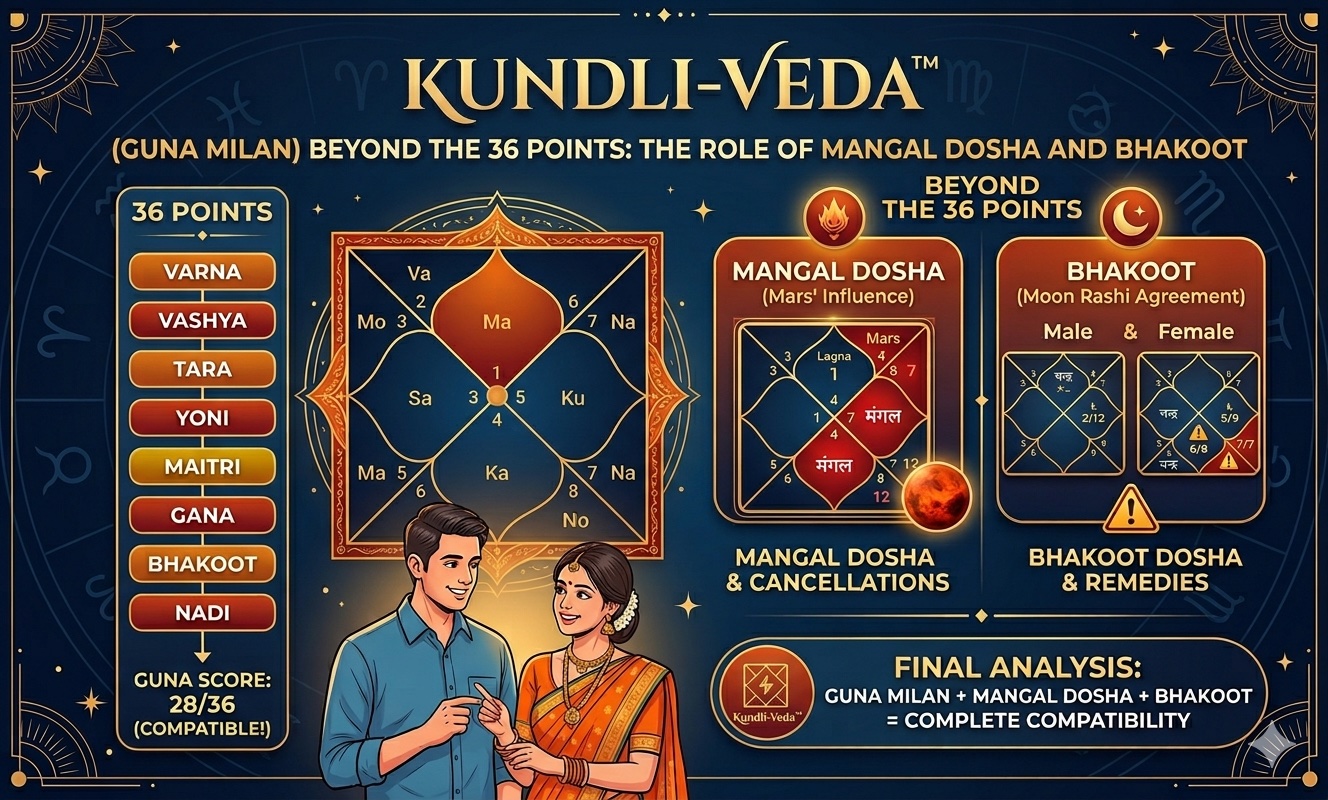
Kundli Matching, also known as Ashtakoot Milan or Guna Milan, is the Vedic astrological process of assessing compatibility between two individuals for marriage. It does this by comparing the positions of the Moon in both birth charts across eight different dimensions (koots), each carrying specific points.
Overall compatibility A score of 18 or above is generally considered acceptable for marriage. 24 and above is considered good.
30 and above is considered excellent. But here's what most people never hear: the number is a starting point, not the finish line.
The eight koots assess Moon-based compatibility, which is vital but human relationships are governed by far more than the Moon's placement alone. The Sun, Mars, Venus, Jupiter, Saturn, and the rising sign (Ascendant) all play crucial roles in shaping a person's identity, desires, and destiny.
That's why experienced Vedic astrologers always analyze the full birth chart alongside the Guna Milan score and that's why Mangal Dosha and Bhakoot Dosha require separate, careful examination. Understanding Bhakoot: The 7-Point Parameter That Causes the Most Panic Bhakoot is the second-highest scoring koot in Guna Milan, carrying 7 points.
It is calculated based on the relative positions of the Moon signs of the two individuals. When the Moon signs are in certain relationships to each other, a Bhakoot Dosha is said to form and those 7 points are reduced to zero.
In classical texts, it is associated with financial instability, health challenges, and, in extreme interpretations, shortened lifespan of partners. But Here's What the Texts Also Say (And What Most People Never Hear)
Ancient Vedic astrology texts the Brihat Parashara Hora Shastra, Muhurta Chintamani, and others — all acknowledge cancellations (parihara) of Bhakoot Dosha. Bhakoot Dosha is considered cancelled or significantly neutralized under the following conditions:
1. Same Rashi Lord (Lord of Moon Sign) If both partners' Moon signs are ruled by the same planet, Bhakoot Dosha is cancelled. For example, if both partners have Moons in signs ruled by Venus (Taurus and Libra), the dosha does not apply.
2. Same Navamsa Rashi If the Navamsa (the 9th harmonic chart, representing the soul and marriage) positions are compatible, Bhakoot Dosha loses its potency.
3. Graha Maitri Score is High If the Graha Maitri koot (which governs mental compatibility) scores 4 or 5 out of 5, it significantly mitigates Bhakoot Dosha's negative effects.
4. Nadi Dosha is Absent When there is no Nadi Dosha, and the overall Guna Milan score is 25 or above even without the 7 Bhakoot points, many astrologers consider the match acceptable.
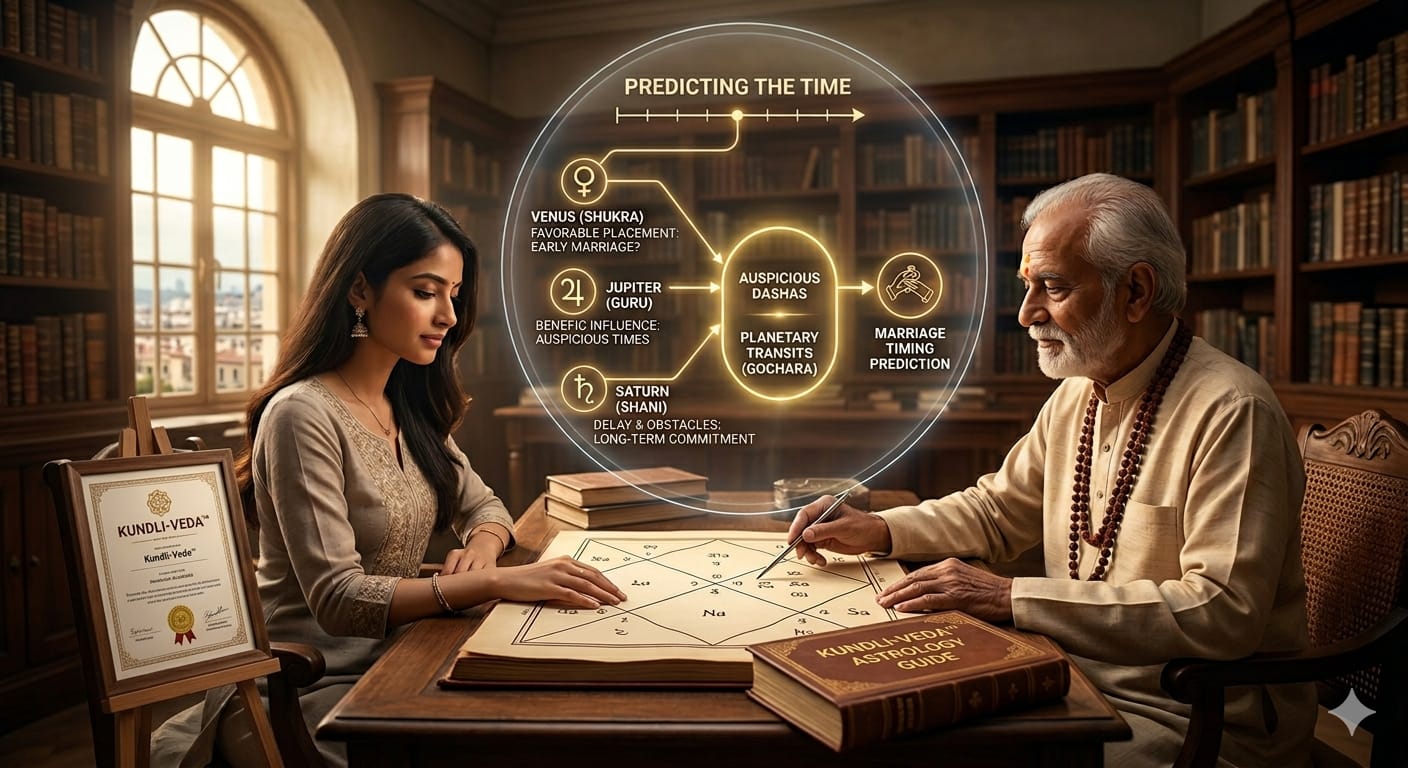
5. Strong Venus and Jupiter in Both Charts Venus (Shukra) is the planet of love and marriage. Jupiter (Guru) is the planet of wisdom, protection, and blessings. When both are strong, well-placed, and unafflicted in both horoscopes, they provide a powerful protective shield.
Let's demystify it, once and for all.
What Is Mangal Dosha? Mangal Dosha (also called Kuja Dosha or being "Mangalik") occurs when Mars (Mangal/Kuja) is placed in certain houses in the birth chart.
This is why you'll encounter disagreement even among learned astrologers about whether someone is Mangalik. The concern behind Mangal Dosha is rooted in Mars's nature.
Mars is a planet of energy, aggression, passion, and independence. When Mars sits in marriage-related houses (particularly the 7th and 8th), it can in certain configurations create friction in partnerships, stubbornness, impulsiveness, or, in classical texts, challenges to the partner's wellbeing.
When both Mangal Dosha and Bhakoot Dosha appear in a match, the initial reaction is often panic. "Two doshas!
" But this is incorrect reasoning.
Doshas interact and modify each other. The presence of two doshas does not mean double the trouble it means the chart requires a comprehensive, holistic reading.
Step 2: Assess the Overall Strength of Both Charts Look at: The Lagna (Ascendant) and its lord The 7th house (marriage) and its lord in both charts Venus (significator of marriage and love) in both charts Jupiter (significator of husband in a female chart) The Navamsa chart (D9), which is the deepest indicator of marriage quality
Step 3: Examine the Dasha Periods A dosha that activates during a challenging planetary period (like Saturn's Sade Sati or Mars's Mahadasha) requires more attention than one that activates during a strong, protective period (like Jupiter's Mahadasha).
Step 4: Look for Planetary Strength and Support Strong, well-placed benefics Jupiter, Venus, and a strong Moon — in both charts provide a supportive foundation that can absorb the challenges indicated by doshas.
Step 5: Evaluate Compatibility Beyond the Moon Composite analysis of Sun signs (for ego and identity), Venus signs (for love language and affection), and the Ascendant lords (for overall life path compatibility) adds depth to the picture. The bottom line: Two doshas with multiple cancellations and strong benefics can indicate a better match than a "clean" chart with weak planetary support for marriage.
Real-World Perspectives Let's talk about something that rarely gets discussed openly: the limitations of a purely algorithmic approach to love. The Guna Milan system was developed over thousands of years, primarily in an agrarian, community-based society where marriage meant a merging of two family ecosystems.
The parameters Nadi, Gana, Yoni reflect biological, temperamental, and social compatibility factors that were critically important in that context. They still matter.
They matter a great deal.
We have seen couples with scores of 19, multiple doshas, and "inauspicious" combinations build extraordinary, loving partnerships because they shared values, communicated openly, and worked together through challenges. What Guna Milan measures is a set of cosmic indicators potential tendencies, areas of harmony, and areas of friction.
It is a map, not the journey. What it cannot measure includes personal growth, emotional maturity, the willingness to communicate, shared life goals, individual trauma healing, spiritual alignment (beyond the surface), and the sheer, irreducible mystery of why two people choose each other.
This is not to dismiss Vedic astrology. On the contrary understanding your chart and your partner's chart is one of the most powerful tools you can have in a relationship.
It helps you see each other with compassion, understand patterns, anticipate challenges, and leverage strengths. But it must be used as wisdom, not as a weapon.
Nadi represents the biological and energetic constitution of a person, mapped through the birth Nakshatra (lunar mansion). There are three Nadis: Adi (Vata), Madhya (Pitta), and Antya (Kapha). When both partners share the same Nadi, a Nadi Dosha forms, and all 8 points of the Nadi koot are lost.
Classically, Nadi Dosha is associated with health challenges, issues with progeny, and in extreme cases, shortened longevity. It is considered more serious than Bhakoot Dosha and, by many, more serious than Mangal Dosha.
The Role of the Navamsa Chart in Marriage Compatibility No discussion of Kundli matching is complete without the Navamsa chart (D9). The Navamsa is the 9th divisional chart and is, in Vedic astrology, considered the most important chart after the Rashi (birth) chart for matters of marriage, spirituality, and the deeper self.
The word "Nava" means nine and "Amsa" means division together, each zodiac sign is divided into nine equal parts. An experienced astrologer reading marriage compatibility will always read the Navamsa alongside the Rashi chart.
Its energy is being channeled through the soul level in a constructive direction. Conversely, a Mars that does not create technical Mangal Dosha in the Rashi chart but is debilitated or poorly placed in the Navamsa may create relationship friction that a surface-level reading would miss entirely.
This is why Kundli-Veda™ compatibility analysis always includes the Navamsa because the full picture requires it.
Practical Remedies for Mangal Dosha and Bhakoot Dosha If, after careful analysis, Mangal Dosha or Bhakoot Dosha remains a concern without complete cancellation, Vedic astrology offers a range of remedies (upayas). These are not superstitions they are practices designed to shift the practitioner's consciousness, create positive karma, and invoke specific planetary energies.
Remedies for Mangal Dosha 1. Kumbh Vivah (Symbolic Marriage) One of the most well-known traditional remedies, where the Mangalik individual first performs a symbolic marriage to a Peepal tree, banana tree, or an idol of Lord Vishnu.
The belief is that the "first marriage" absorbs the dosha's energy, freeing the actual marriage from its influence. This is a cultural practice and should be approached with personal discretion and guidance from a trusted spiritual advisor.
2. Worship of Lord Hanuman Mars is associated with energy, courage, and strength.
Lord Hanuman, the embodiment of selfless service and controlled power, is the deity most closely aligned with Mars's positive expression. Reciting the Hanuman Chalisa on Tuesdays (Mars's day) is a widely recommended practice.
3. Mars Mantra Japa The recitation of the Mangal (Mars) Beej Mantra "Om Kraam Kreem Kraum Sah Bhaumaya Namah" — 108 times on Tuesdays is said to invoke the positive qualities of Mars and reduce its malefic influence.
However, gemstones should only be worn after a professional consultation, as wearing the wrong stone can aggravate a dosha rather than reduce it. 5.
Charitable Acts Associated with Mars Donating red-colored items (lentils, red cloth), copper objects, or contributing to causes associated with soldiers, athletes, or first responders on Tuesdays are considered Mars-harmonizing acts. 6.
Keeping Fast (Vrat) on Tuesdays
Observing a fast on Tuesdays with prayer to Lord Hanuman or Lord Kartikeya (who governs Mars) is a classical remedy. Remedies for Bhakoot Dosha
1. Worshipping the Ruling Planet of Both Moon Signs Since Bhakoot Dosha involves the Moon sign lords, strengthening and worshipping the relevant planetary deities is the primary recommendation.
If the Moon is in Taurus and Libra (both ruled by Venus), performing Venus remedies wearing white on Fridays, worshipping Goddess Lakshmi, offering white flowers can be beneficial. 2.
Navagraha Puja A comprehensive Navagraha puja that honors all nine planetary intelligences creates a balanced energetic field and is often recommended when multiple doshas exist. 3.
Mahamrityunjaya Mantra For Bhakoot Dosha related to longevity concerns (particularly the 6-8 combination), the Mahamrityunjaya Mantra is traditionally recommended. It is associated with Lord Shiva's power over time and transformation, and its regular recitation is considered profoundly protective.
4. Matching Puja Together Many temples that specialize in Vedic marriage rituals offer combined pujas for couples with Bhakoot Dosha.
Performing this puja together before the marriage ceremony is considered a powerful harmonizing act. An Important Note on Remedies: Remedies in Vedic astrology are tools of intention, awareness, and karmic redirection.
They work best when accompanied by conscious inner work —honest communication in the relationship, commitment to growth, and the cultivation of qualities like patience and compassion. A mantra recited without sincerity is just sound.
A mantra recited with genuine devotion becomes a transformative practice. When the Stars Are Challenging and Love Is Real: How to Move Forward Let's come back to real life for a moment.
If you are reading this because someone you love has a "problematic" Kundli, or because your own chart is raising alarms, here is what we want you to know: You are not your dosha. Mangal Dosha does not make you dangerous to love.
Bhakoot Dosha does not doom your relationship. These are energetic patterns tendencies, not fates.
And every tendency can be understood, worked with, and navigated with wisdom. The couples who thrive, regardless of what their charts say, share a few common traits: They communicate honestly.
They talk about the hard things — money, family, desires, fears before the wedding, not after. They respect each other's nature.
A Mangalik partner often has tremendous drive and passion. A partner who understands and appreciates that will experience it as fire that warms their home, not one that burns it.
They do the inner work. They seek to understand themselves — their patterns, their wounds, their needs and they bring that self-awareness into the relationship.
They take the astrological guidance seriously but not rigidly. They use the wisdom of the stars to inform their choices and deepen their understanding, while remembering that free will and consciousness are the most powerful forces in any human life.
The stars incline. They do not compel.
Genuine Vedic astrology is a science of compassion and illumination. Frequently Asked Questions Q: If both partners are Mangalik, is the match automatically safe?
Yes, in most traditional interpretations, this is the primary cancellation for Mangal Dosha. However, other chart factors should still be examined for overall compatibility.
Q: Can a Mangalik person marry a non-Mangalik person? Yes, absolutely particularly when other cancellation conditions apply, or when a thorough chart reading by a qualified astrologer shows overall compatibility and planetary strength.
Q: Is Bhakoot Dosha worse than Mangal Dosha? They are different in nature.
Bhakoot Dosha relates specifically to the emotional and material flow between partners. Mangal Dosha relates to Mars's expression in marriage-related houses.
Neither is categorically "worse" both require careful analysis of cancellations and the full chart. Q: My Guna Milan score is only 20 but there are no doshas.
Is the match okay? A score of 20 without any doshas, and with good planetary strength for marriage in both charts, is often considered an acceptable match by experienced astrologers.
The absence of serious doshas (particularly Nadi Dosha) is itself a positive indicator. Q: Can Mangal Dosha be cured permanently?
Vedic tradition offers remedies that significantly reduce the malefic influence of Mangal Dosha. Whether one considers them "permanent cures" is a matter of personal and spiritual perspective.
Consistent practice of the recommended remedies over time, combined with conscious relationship work, creates meaningful positive shifts. Q: At what age does Mangal Dosha reduce?
Many classical and contemporary astrologers believe that Mangal Dosha's intensity reduces significantly after age 28, and substantially after age 35. However, this should not be used as a reason to delay seeking guidance or taking appropriate remedial measures.
Astrology as Wisdom, Not as Verdict
That is what Vedic astrology is for. Not to frighten.
Not to divide. But to illuminate —to help two people see each other more clearly, love each other more wisely, and walk their shared path with their eyes open and their hearts full.
The 36 points matter. But they are not the whole story.
Your story is written in the fullness of your chart, your choices, your consciousness, and the love you choose to cultivate every single day. Ready to Get Your Complete Kundli Matching Analysis?
At Kundli-Veda™, we go beyond the number. Our expert Vedic AI provide a comprehensive, compassionate Kundli matching analysis that covers everything discussed in this guide Guna Milan, Mangal Dosha with all cancellations, Bhakoot Dosha, Nadi Dosha, Navamsa compatibility, and personalized remedies.
We believe in clarity, not fear. We believe in wisdom, not judgment.
Kundli-Veda™ Rooted in Tradition. Guided by Wisdom.
Here for Your Journey. Share this article with someone who needs to read it.
Because love deserves better than fear.